
Invisalign Provider Tiers Explained: Preferred vs Platinum vs Diamond in Dubai
If you have compared two Invisalign clinics in Dubai, you have already noticed it: one advertises itself as a Platinum provider, another as Diamond, and a third mentions nothing at all. The badges look meaningful, they all sit on the same homepages, and nobody explains what the difference actually is. That silence is worth fixing, because the tier system is one of the few genuinely checkable signals in a market where almost every clinic claims to be the best orthodontist in Dubai.
This guide explains exactly what the Invisalign provider tiers are, how Align Technology awards them, what they do and do not tell you about your treatment, how they work in Dubai specifically, and how to verify a provider’s claim in under two minutes before you book a consultation.

What Are Invisalign Provider Tiers?
Invisalign provider tiers are a ranking system operated by Align Technology, the company that manufactures the Invisalign system in which you are considering treatment. They are not a clinical exam result and not an independent quality audit, but rather a volume ranking. Align runs the scheme through what it calls the Advantage Program, and the tiers are principally based on how many new Invisalign cases a practice starts within a defined measurement period, usually a rolling twelve months.
The key facts to hold onto are these:
- a clinician must first be Invisalign certified, which requires formal training and a baseline standard of competency, before a tier even becomes relevant;
- the tier is then earned by case volume submitted through the provider’s Invisalign account;
- status is recalculated periodically, so a practice can move up or down without any change in its clinical ability;
- Align does not publish a single definitive public table of case thresholds, which is why different websites quote different numbers.
That last point matters. If you see a blog confidently stating that Platinum equals exactly 110 cases a year, that figure is second-hand and may well be out of date. Align has revised both the tier names and their thresholds more than once since the program began, adding intermediate levels such as Gold Plus, Platinum Plus and Diamond Plus along the way. Treat any tier list, including the one in this article, as a map of the shape of the ladder rather than a fixed reference table.

How Provider Tiers Are Calculated
Provider status is generally assessed on the number of new Invisalign cases started during the evaluation window. In most versions of the program that has meant a rolling twelve months, though some regional programs have used a shorter period. What counts, per Align’s program rules, broadly includes new first-time Invisalign treatment starts, comprehensive cases and Invisalign Teen cases. Some versions of the program have also worked on a points model, where a completed full treatment or teen treatment carries a set number of points, and each tier requires crossing a points threshold.
What does not determine a provider’s level is arguably more important than what does. The tier is not influenced by:
- the clinical outcome the patients actually achieved;
- how difficult or straightforward the cases were;
- whether the treating clinician is a specialist orthodontist or a general dentist;
- patient satisfaction, complaints or reviews;
- any examination, certification or academic credential beyond the baseline Invisalign training.
Here is the honest summary a clinic’s own marketing page will usually not give you: tier level measures activity, not artistry. It tells you that a practice treats a great many Invisalign patients each year, which is genuinely useful information, and it does not tell you how good the finished result will be.
The Invisalign Provider Tiers, From First Case to Top 1%
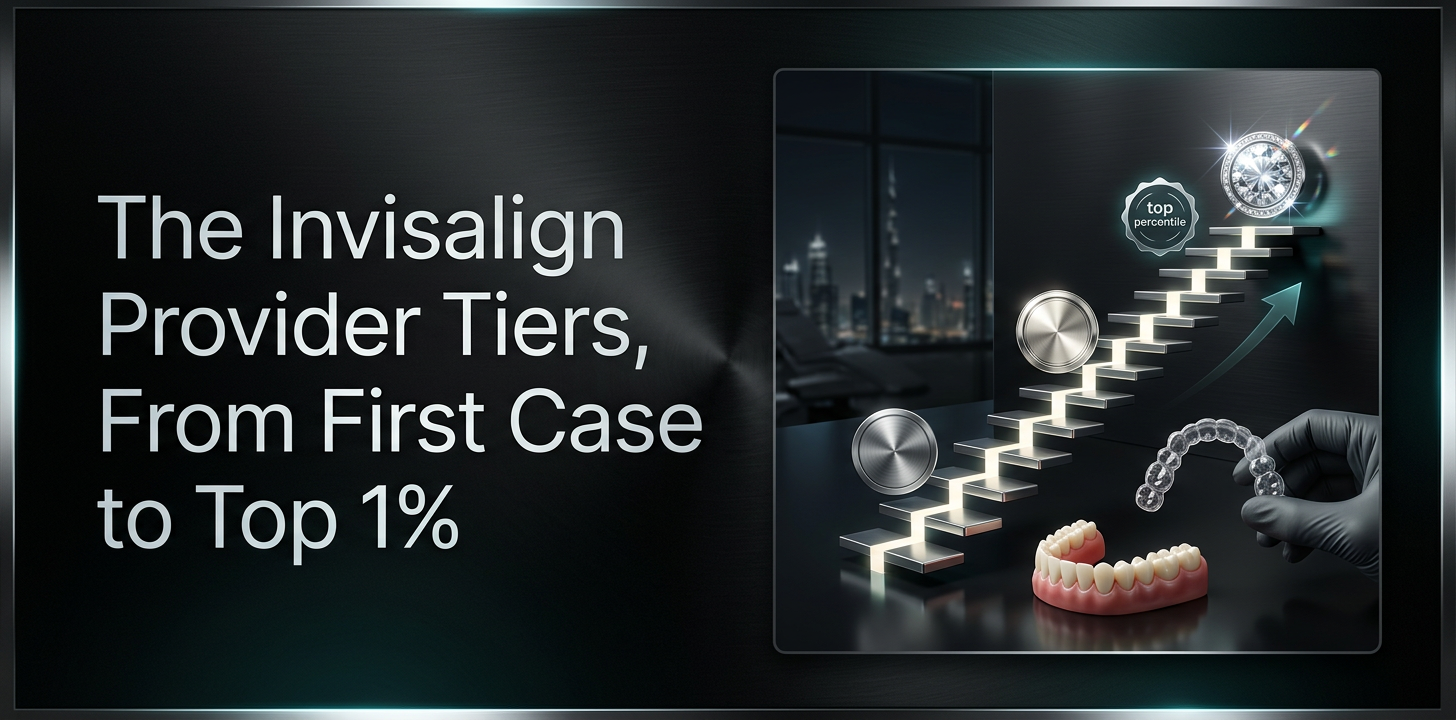
Align’s ladder today runs from Bronze at the entry level up to Diamond Plus, also referred to in some markets and mirrors as Diamond Apex or Blue Diamond. The tiers below describe the shape of the system as it is generally reported; exact thresholds vary by country and by programme revision.
Tier | Roughly what it signals | Typical annual case volume |
Bronze | A newly certified or occasional provider building experience | A handful of cases, roughly 0–10 |
Silver | A growing, regular aligner caseload | Roughly 11–20 cases |
Gold | Aligners are a routine part of the practice, not an occasional service | Roughly 25–60 cases |
Platinum | A high-volume provider with substantial year-on-year aligner experience | Commonly quoted from around 80–150 cases |
Platinum Plus / Platinum Elite | Consistently high volume, clear aligners central to the practice | Roughly 150–300 cases |
Diamond | Among the most active Invisalign providers in the city or country | Roughly 200–400 cases |
Diamond Plus (top 1%) | The highest published tier, held by a very small fraction of providers worldwide | Roughly 400+ cases, with a large lifetime total |
Two clarifications worth adding to that table. First, the tiers are awarded to a practice or a provider account rather than to a country ranking, so a Diamond provider in Dubai is measured against Dubai and UAE case volumes, not against global totals. Second, the intermediate tiers are real but inconsistently marketed. You will find Platinum Plus, Platinum Elite and Diamond Plus used interchangeably across different clinic websites because different markets and different program versions used different labels.
What Actually Changes As A Provider Closes In On Diamond Level?
Moving up the ladder involves more than a marketing upgrade. At the higher volumes a practice must invest in the infrastructure that makes consistent aligner treatment possible:
- digital scanning and 3D imaging rather than impression trays;
- ClinCheck treatment planning as a routine step rather than an occasional extra;
- a workflow for tracking aligner wear, refinements and retention over twelve to twenty-four months;
- auxiliary techniques such as attachment placement, interproximal reduction and bite correction for complex cases;
- case selection judgement, knowing which cases genuinely suit aligners and which should be treated with fixed braces instead.
A provider who starts four hundred cases a year has, by definition, encountered a very wide range of crowding patterns, bite problems, relapse cases and mid-treatment complications. That breadth of exposure is the real value of a high tier, and it is the reason the badge persists in patient conversations despite its limitations.
What the Tiers Do Not Tell You
This section exists because patients consistently over-read the badge, and clinics know it. An Invisalign Diamond provider is not the same thing as the best orthodontist in Dubai, and several specific gaps are worth understanding before you use a tier to choose a clinician.
General Dentists and Specialist Orthodontists Share the Same Ladder
This is the single most important point in this article. Any licensed dentist can offer Invisalign, complete the certification, build case volume and climb the tiers. An orthodontic specialist has taken a different and much longer route: after a dental degree, a full-time residency in orthodontics, typically two to three years focused entirely on tooth movement, bite correction, growth and facial development.
The tier scale does not distinguish between the two. A general dentist with a very busy aligner practice can sit at Diamond level, and a specialist orthodontist with a smaller, more selective caseload can sit at Platinum or below. If you are choosing a provider for anything more demanding than mild crowding, the question to ask is not which tier, but which qualification. A Diamond provider who happens to be a specialist orthodontist gives you both signals at once, which is why that combination is the one worth seeking out.
Tiers Do Not Measure Results
There is no outcome audit, no before-and-after review, no satisfaction threshold attached to a tier. The number is generated from case submissions, not from whether the patient’s teeth finished straight, the bite settled correctly or the result has held five years later. Two providers at the same tier can produce very different experiences and very different endings.
Tiers Recalculate, Reputation Does Not
A practice that reduces its aligner caseload will drop a tier over the following year, while the clinical skill of the clinicians working there continues unchanged. If a clinic’s site shows an outdated badge, that usually reflects a stale website rather than a deliberate misstatement, but it also means the badge you are reading may not reflect the provider’s current status.
Where Tier Level Is Genuinely Worth Weighing
- you want a high-volume practice where aligners are the core service, not a sideline;
- your case is straightforward and the main risks are consistency, follow-up and retained outcomes;
- you value efficient appointment systems, digital monitoring and predictable refinements;
- you want confidence that the practice has handled many variations of your particular problem.
Where tier level should not be your deciding factor
- your case is complex, involves a significant bite problem or requires skeletal movement;
- you have had previous orthodontic treatment that relapsed;
- you are a growing child or teenager where growth timing affects the plan;
- the provider’s tier outranks their actual qualification for the work you need done.
How Invisalign Tiers Work in Dubai
Dubai has an unusually dense Invisalign market. The city has dozens of DHA-licensed Platinum and Diamond providers, concentrated in areas such as Jumeirah, Business Bay, Jumeirah Village Circle, Dubai Healthcare City, Jumeirah Lakes Towers and the Dubai Silicon Oasis corridor. In a market that crowded, the same system that makes tiers useful globally creates a specific local problem: when fifteen clinics within a twenty-minute drive all advertise Diamond or Platinum status, the badge stops being a differentiator and becomes background noise.
What Dubai Patients Should Actually Compare
Because tier level is so widely held at the top end in Dubai, the more useful comparison sits alongside it:
What to compare | Why it matters in Dubai |
Specialist orthodontist vs general dentist | The tier does not tell you which you are booking, and in a dense market this is the sharpest quality signal available. |
DHA licensing and registration | Every treating clinician must be registered. Check the Dubai Health Authority register, not just the website. |
Provider tier, verified on the Invisalign locator | Confirms the badge is current rather than a screenshot from an older program year. |
What the quote actually includes | Retainers, refinements, X-rays and whitening are sometimes billed separately, so compare all-in totals rather than headline prices. |
ClinCheck simulation offered before commitment | Lets you see the projected outcome and judge the plan quality before paying. |
Review volume and depth, not just rating | A 5.0 rating from forty reviews is far weaker evidence than 4.9 from eight hundred. |
The Dubai Pricing Reality
Tier and price are related but not proportionate. Across published Dubai clinic pricing in 2026, Invisalign treatment generally sits between roughly AED 7,000 and AED 30,000 depending on case complexity and package tier. A Platinum provider working from a Business Bay clinic may quote less than a smaller provider in a premium location, and vice versa, because overheads, location and package structure affect price at least as much as provider tier does. A higher tier with a transparent all-in quote is a better proposition than a lower tier with a low headline figure and separately billed extras.
Where the Badge Is Genuinely Meaningful in Dubai
The higher tiers matter most in this market for a specific reason: the population is transient. Many patients begin treatment in one country and finish in Dubai, or start in Dubai and move on before completion. A provider with very high annual volume has almost certainly handled transfer cases, mid-treatment refinements and the documentation required by insurers, which is exactly the experience relevant to a mobile population. In that context, the volume behind the badge translates into real practical capability.
Meet Dr. Basel Mofti: Dubai’s Invisalign Diamond Top 1% Provider
A worked example makes all of this concrete, because the most useful position for a patient is a provider who satisfies both halves of the signal at once: the highest tier and the qualification behind it.
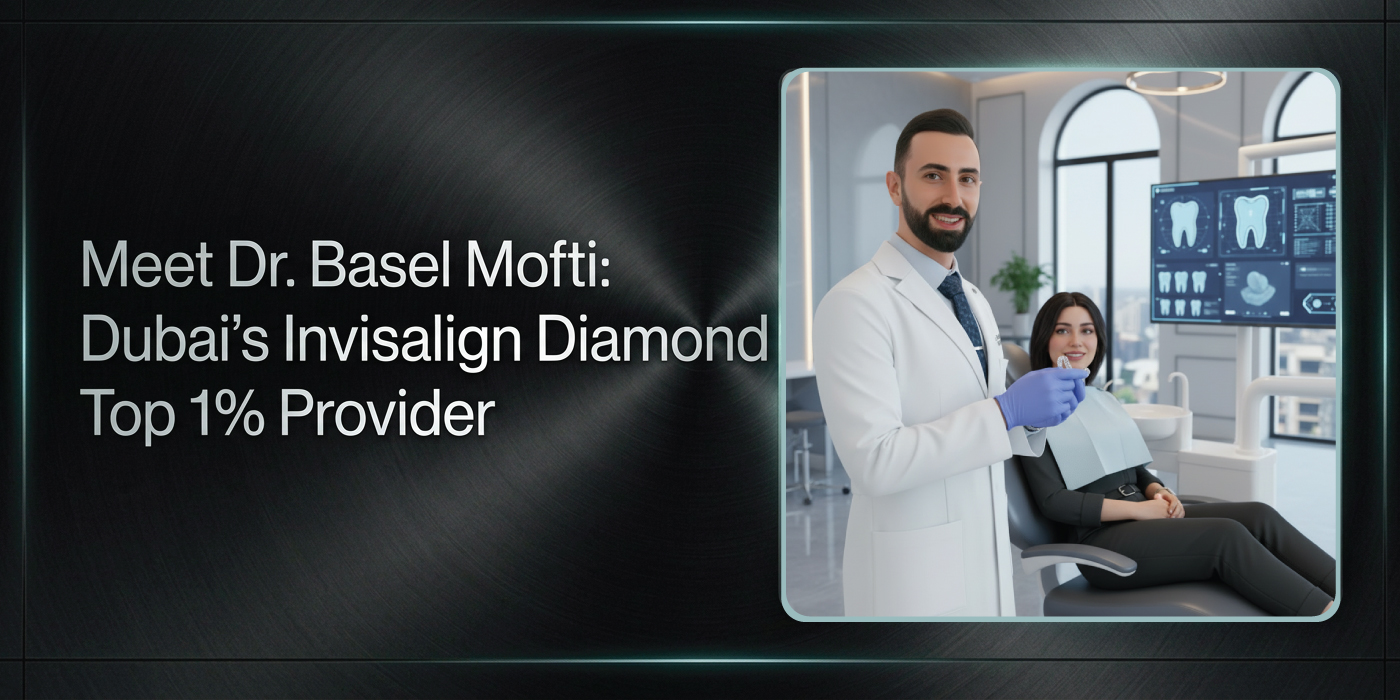
Dr. Basel Mofti is a UK board certified Specialist Orthodontist and an Invisalign Diamond Top 1% provider, based at Dr. Joy Dental Clinic in Jumeirah Village Circle and practising across Dubai. He is a combination of the two credentials that this article has argued are worth separating: a specialist orthodontist by training, and a provider at the top end of Align Technology’s published ladder by case volume.
Credentials and Background
Dr. Mofti holds a BDS together with MFDS from the Royal College of Surgeons of Edinburgh, an MSc in Orthodontics, and Membership in Orthodontics from both the Royal College of Surgeons of England and the Royal College of Physicians and Surgeons of Glasgow. He was born and raised in the United States, completed his specialist studies in the United Kingdom, and then relocated to the UAE, where he practises and lives. He has over a decade of clinical experience and has been listed at roughly thirteen to fourteen years in practice on professional directories.
Alongside his clinical work, Dr. Mofti is an Adjunct Clinical Professor and Director of the aligner division in the orthodontic residency programme at Ajman University, which means he trains specialist orthodontists in aligner treatment rather than only delivering it. He practises in English, Arabic and German.
Treatment Philosophy
Dr. Mofti describes his approach as face-driven orthodontics: the objective is not only straight teeth but facial harmony and balance, with the tooth movement planned in relation to the face rather than treated as an isolated problem. In practical terms, his practice uses 3D radiography and intraoral digital scanning so that planning is personalised rather than templated, and the projected outcome can be reviewed with the patient before treatment begins.
What the Diamond Top 1% Status Means in His Case
Read against everything above, the badge here carries more weight than it usually would. It confirms very high annual aligner case volume and years of accumulated experience, and because the same clinician is a UK-trained, board-certified specialist orthodontist, the volume is paired with formal training in orthodontics rather than standing in for it. That is the combination this guide has been pointing at throughout: the tier tells you how many cases the practice handles, and the qualification tells you who is deciding what to do with them.
Practical Information
- Primary location: Basel Mofti Orthodontics & Invisalign, Circle Mall, Dr. Joy Dental Clinic, Jumeirah Village Circle, Dubai
- Also practising at: Joy Dental Clinic — additional branches including Dubai Silicon Oasis, Jumeirah and Palm Jumeirah
- Treatments: Specialist orthodontics, Invisalign and clear aligners, Invisalign Teen, metal and ceramic braces, lingual braces, Damon self-ligating braces, retention and retainers
- Languages: English, Arabic and German
Patient feedback across professional directories and review platforms is consistently strong, with review counts in the hundreds rather than the dozens, which is a far more reliable sample than a perfect rating from a small handful of patients. Recurring themes in that feedback are treatment planning detail, clear explanation, and results that matched or exceeded the plan shown at the start.
How to Verify Any Invisalign Provider Tier in Dubai
You do not have to take a clinic’s word for its badge. The verification takes a couple of minutes and should be done before any consultation.
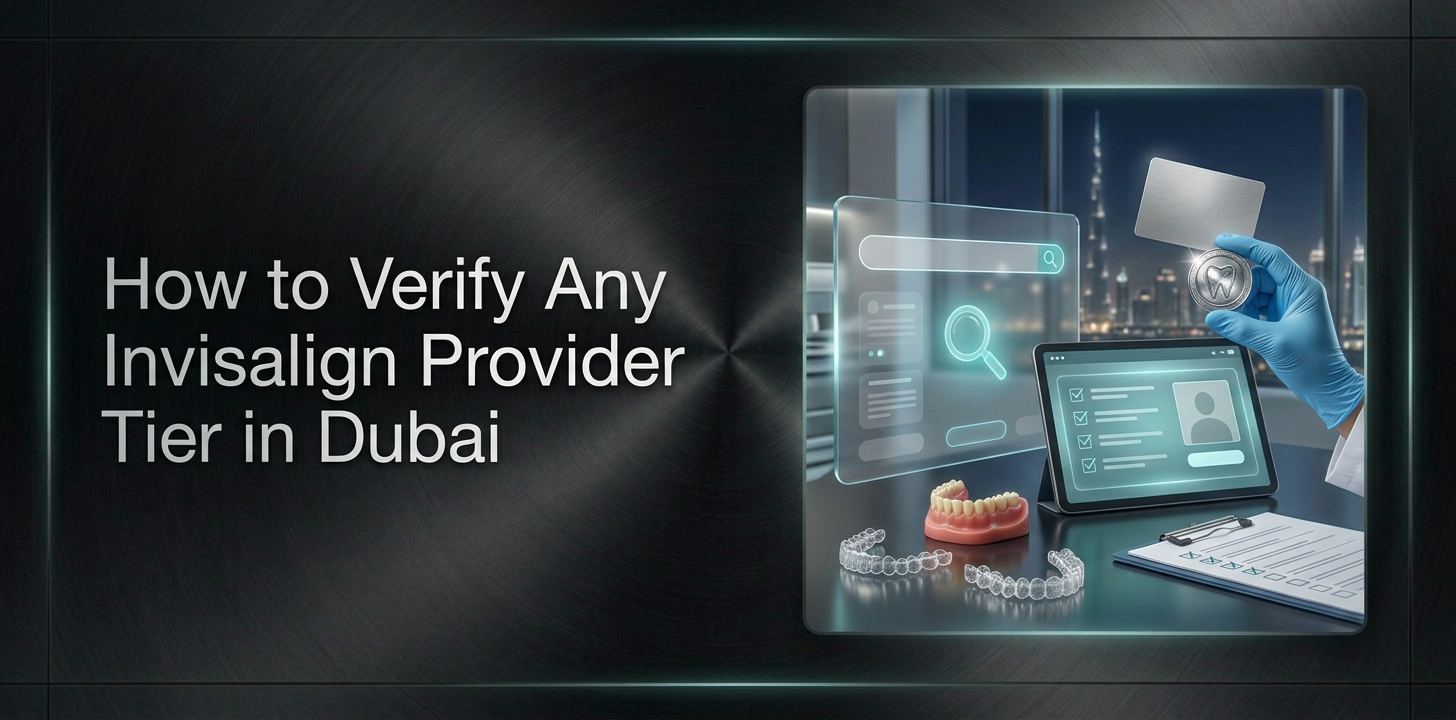
- Open the official Invisalign doctor locator. Align maintains its own public locator at the Invisalign website, including the UAE version. This is the authoritative source, and any badge list on a clinic website is a claim about it.
- Search the provider’s name and city. The locator returns a profile showing the provider’s designation, the practice they are associated with and, where applicable, the tier. Profiles also indicate specialisations, such as Invisalign Teen treatment.
- Check that the tier on the profile matches the clinic’s website. A mismatch may simply mean the clinic site has not been updated since the last programme recalculation, so ask which is current.
- Confirm DHA registration. In Dubai, cross-check that the treating clinician is registered with the Dubai Health Authority, and confirm whether they are registered as a specialist orthodontist or a general dentist.
- Read the profile qualifications carefully. The designation tells you volume. The letters after the name tell you training. Both matter, and the locator shows both.
- Ask at the consultation who will do the planning. Some high-volume practices begin treatment under a general dentist and refer complex cases upward. Find out before you pay.

What to Ask About Tier Status at Your Consultation
A short script for the appointment. These questions separate a practice that uses its tier as marketing from one that has the clinical depth behind it:
- Are you a specialist orthodontist or a general dentist, and are you registered with the DHA in that category?
- What is your current Invisalign provider tier, and can we check it on the official locator together?
- Is the tier held by you personally, by the clinic, or by a colleague who may not be treating me?
- How many cases like mine do you treat in a year?
- Has your tier changed in the last twelve months, and if so, why?
- Which parts of my treatment might be better served by fixed braces, and would you tell me if that were the case?
- What is included in the quote — all aligners, refinements, retainers, scans, X-rays and post-treatment reviews?
- What happens if my teeth do not track to plan and refinements are needed?
A provider who answers these directly, including the uncomfortable ones, is telling you more about the quality of your treatment than any badge is capable of.

Frequently Asked Questions
Invisalign provider tiers are a ranking system run by Align Technology through its Advantage Program. They run from Bronze at entry level through Silver, Gold, Platinum, Platinum Plus or Platinum Elite, Diamond, and up to Diamond Plus, which represents roughly the top one per cent of providers. The levels are based principally on the number of new Invisalign cases a provider starts within a defined measurement period, usually a rolling twelve months, and are reassessed periodically.
Align does not publish one definitive public threshold table, which is why different sources quote different numbers, and because thresholds vary by country and have changed across program revisions. As generally reported, Platinum begins somewhere in the region of eighty to one hundred and fifty cases a year, Diamond sits around two hundred to four hundred, and Diamond Plus typically requires more than four hundred annual cases alongside a high lifetime total. Treat all such figures as indicative rather than official.
Not necessarily. Tier level measures case volume, not clinical outcomes. There is no exam, no result audit and no patient satisfaction threshold attached to a tier. A higher tier does mean the provider has handled a very large number of cases and will have encountered a wide range of clinical situations, which is valuable. It does not tell you how well those cases finished, and it does not distinguish between a specialist orthodontist and a general dentist, both of whom can reach the top tiers.