
Myobrace in Dubai for Kids: A Parent’s Complete Guide to Straight Teeth Without Braces
If your child breathes through their mouth at night, snores softly, or their dentist has already hinted that “we’ll need to watch the crowding,” you have probably come across the word Myobrace. It is one of the few names in children’s dentistry that promises something genuinely different: not straightening crooked teeth after the fact, but guiding the way a child’s jaw, tongue and airway develop in the first place.
For parents in Dubai, the appeal is obvious. Orthodontic treatment here is a real investment, and anything that reduces how much of it your child needs later is worth understanding properly. This guide covers what Myobrace actually is, which children it suits, how the treatment runs week to week, what it costs in the UAE, and the questions worth asking before you commit.
What Is Myobrace?
Myobrace is a preventive, pre-orthodontic system built around a series of soft, removable appliances that a child wears for one to two hours during the day and overnight while sleeping. It was developed in Australia by MRC (Myofunctional Research Co.) and is used by trained dentists and orthodontists worldwide.
The core idea is simple. Crooked teeth and narrow jaws are usually not the problem — they are the result of a problem. That underlying problem is a set of poor oral habits, collectively called myofunctional habits:
- Mouth breathing instead of nasal breathing
- Incorrect tongue posture — the tongue resting low or pushing against the front teeth rather than sitting in the roof of the mouth
- Tongue thrust — pushing the tongue forward against the teeth when swallowing or speaking
- Reverse or incorrect swallowing patterns
- Thumb sucking, lip sucking or prolonged pacifier use
- Lips that stay apart at rest
These habits change the way the muscles around the face work, and muscles shape bone. A child whose tongue never rests in the palate does not get the natural widening that the tongue provides, so the upper jaw stays narrow. With a narrow jaw there is not enough room for the teeth, so they erupt crowded. Traditional braces then move those crowded teeth into a better position — but in a jaw that is still the same size.
Myobrace takes the opposite route. It retrains the habits, encourages nasal breathing and proper tongue rest, and supports the natural development of the arch so that teeth have room to come through straight.
Why Mouth Breathing Matters More Than Most Parents Realise
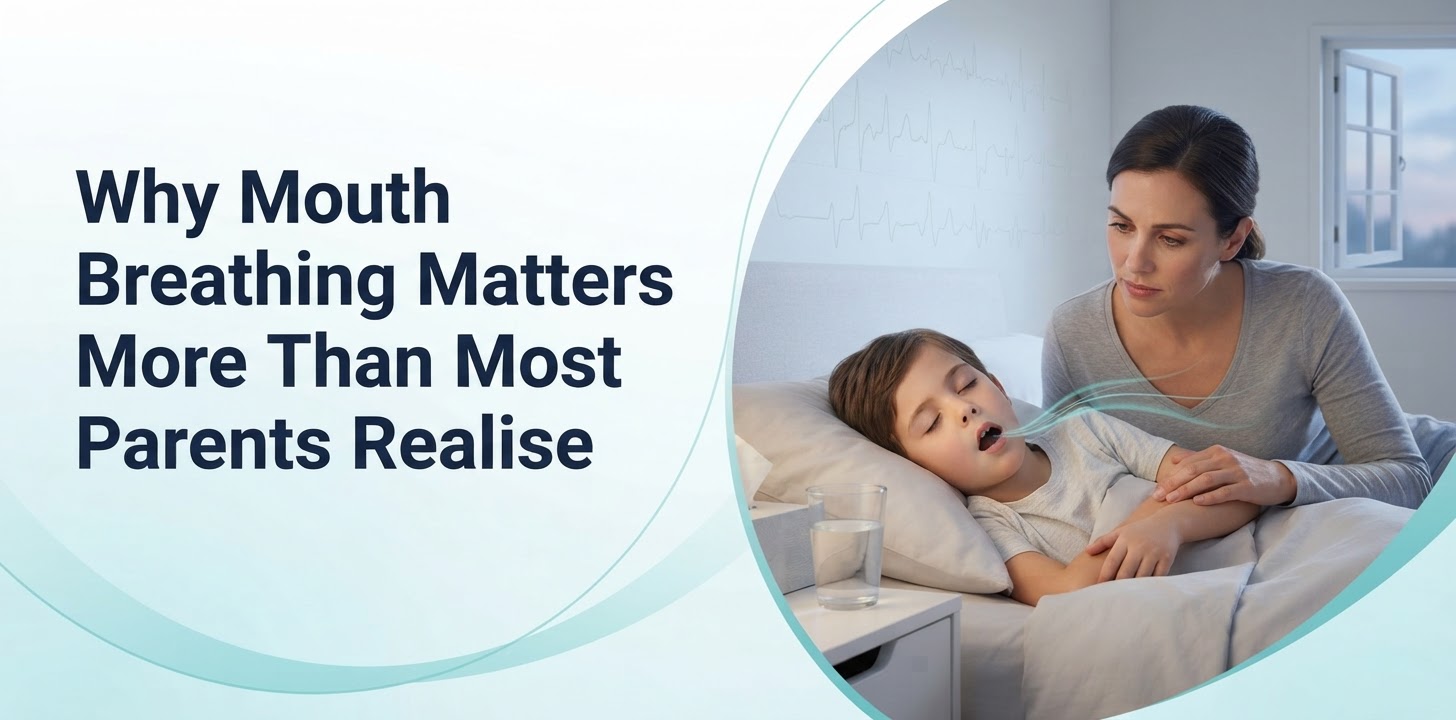
The habit most parents dismiss — mouth breathing — is the one clinicians watch most closely. Children who breathe through their mouths chronically tend to have lower tongue posture, longer faces, narrower palates and higher rates of snoring and disturbed sleep. The link works in both directions: a blocked nose from allergies or enlarged adenoids pushes a child toward mouth breathing, and mouth breathing then reinforces the facial growth pattern that makes nasal breathing harder.
Dubai adds its own layer to this. Dust, high pollen counts in season, long stretches of indoor air conditioning and the sheer amount of time children spend in air-conditioned, filtered air all mean allergic rhinitis is extremely common in the UAE. A large share of children who mouth-breathe here are doing so because their nose is genuinely congested rather than because of habit alone.
That matters practically. If your child’s nose is blocked, no appliance will fix the breathing pattern on its own. Good Myobrace practitioners assess the airway first — sometimes referring for an ENT opinion or allergy management — and then use the appliance to consolidate nasal breathing once the nose is clear. Some clinics pair this with myofunctional therapy exercises that strengthen the tongue and lip muscles deliberately, which is where much of the real change happens.

Is Myobrace Proven? What the Research Says
This is a fair question, and the honest answer is that the evidence base is growing rather than settled.
A 2025 study published in the International Journal of Clinical Pediatric Dentistry looked specifically at early intervention with the Myobrace appliance in children aged 6–10 with Class I, II and III malocclusions. The authors reported significant improvements across all three classes — better arch alignment and space management in Class I, mandibular advancement and maxillary restraint in Class II, and maxillary growth promotion with anterior crossbite correction in Class III. Their conclusion was that the appliance offers an effective, non-invasive early intervention that can reduce the severity of malocclusions and potentially minimise the need for complex orthodontic procedures later.
What the research does not show is that Myobrace replaces braces for every child, or that results are guaranteed. Outcomes track closely to two things: how well the child complies with wearing the appliance and doing the exercises, and the child’s own growth pattern. The manufacturer is explicit about this — success “relies on compliance and the child’s ability to correct their poor myofunctional habits.”
Treat Myobrace as a well-supported early intervention with real evidence behind it, not as a magic alternative to orthodontics.
What Age Should a Child Start Myobrace?
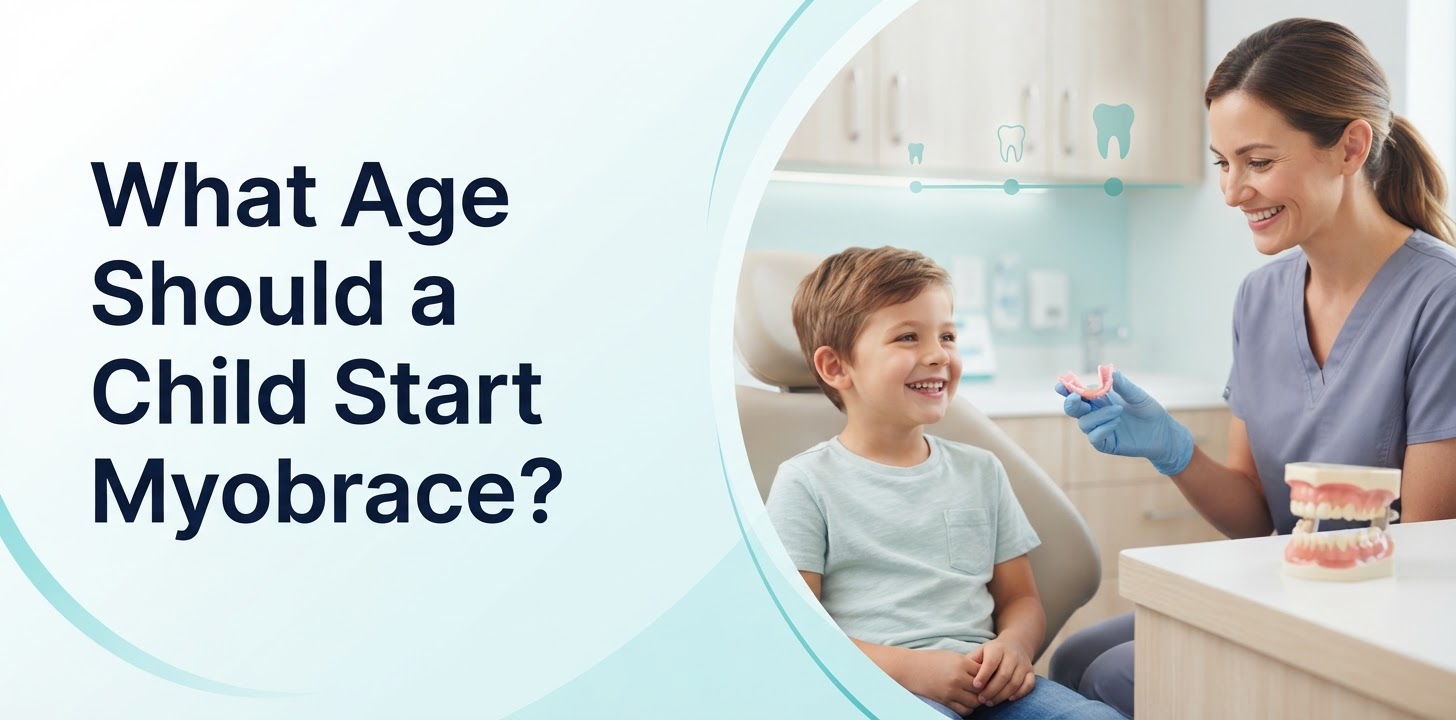
The manufacturer recommends treatment for children aged 3 to 15, and states that the ideal window is between 5 and 10 years old. That range surprises parents who expect orthodontics to start in the teens, so it is worth unpacking.
The window matters because habits are easier to change before they are entrenched, and because jaw growth is most responsive while it is actively happening. By 5 to 10, a child still has a mix of baby and adult teeth — which is exactly the point. The appliance is not moving adult teeth into place; it is creating the conditions under which they will erupt correctly.
A rough guide by age:
Age | What’s happening | Typical focus |
3–5 | Baby teeth present, habits forming | Habit correction, thumb sucking, mouth breathing |
5–8 | Mixed dentition begins | Habit correction plus early arch development |
8–10 | Peak growth window | Arch development, guiding eruption, alignment begins |
10–15 | Permanent teeth erupting | Alignment and retention, sometimes alongside braces |
Should an older child be ruled out? No. Teenagers up to around 15 can still benefit, particularly with the Myobrace for Teens appliance, but the treatment often becomes a partner to conventional orthodontics rather than a replacement for it. If your child is already 13 and has significant crowding, a specialist will usually tell you honestly that braces will do part of the job.
One reassuring note the manufacturer makes directly: it is entirely normal for a child starting at 5 to 10 to have only a few adult teeth.

Signs Your Child Might Be a Candidate
Parents often notice the signs long before a dentist does. If two or more of these sound familiar, an assessment is worth booking:
- Your child breathes through their mouth during the day, at night, or while watching television
- Snoring, restless sleep, or waking with a dry mouth
- Lips that do not meet comfortably at rest
- Crowded, overlapping or rotated teeth, or teeth that came in noticeably late
- A narrow-looking upper jaw or a “V-shaped” palate
- A habit of thumb sucking, lip sucking, nail biting or chewing on clothing
- Speech sounds — particularly “s” and “th” — that are still unclear past age six or seven
- Food that falls out of the mouth during eating, or trouble swallowing
- Grinding teeth at night
- A dentist or paediatrician who has mentioned “watch this bite” or “we’ll see an orthodontist later”
Myobrace is not suitable for every child, and no ethical clinic will pretend otherwise. Growth patterns, the type of malocclusion, airway status and the child’s willingness to cooperate all affect whether it is the right tool.
How Myobrace Treatment Works: The Four Stages
Myobrace is not a single appliance. It is a sequence — typically three or more appliances used over the programme, each suited to a stage of growth and a specific goal. The manufacturer describes four stages.
Stage 1 — Habit Correction
The foundation. The child learns to breathe through the nose rather than the mouth, to rest the tongue in the correct position against the palate, to swallow properly, and to keep the lips together when not eating or speaking. The first appliance is soft and flexible, designed to be comfortable enough that young children tolerate it. Daily exercises — short, playful tongue and breathing activities — run alongside the appliance.
Stage 2 — Arch Development
With habits improving, the focus shifts to widening the upper jaw so there is genuine space for the tongue and for teeth to erupt into. Where additional development is needed, especially in children over seven with underdeveloped jaws, practitioners may combine Myobrace with techniques such as Biobloc or the Farrell Bent Wire System. The Myolay appliance is used for younger children alongside Myobrace.
Stage 3 — Dental Alignment
As the last permanent teeth erupt, the Myobrace for Teens appliance guides teeth into their natural position. This is the stage where compliance matters most — a removable appliance only works when it is in the mouth. Depending on the case, some final alignment may still involve a short period of braces; where it does, Myobrace for Braces can be used alongside to keep the habit gains.
Stage 4 — Retention
The last stage exists to lock in the new habits so the teeth hold their position. This is one of the quieter advantages of the approach: because the underlying muscle function has changed, many children avoid the indefinite fixed retainer that follows conventional orthodontics.
What a Typical Day Looks Like
The daily routine is where treatment succeeds or fails. The standard prescription is one to two hours of wear during the day plus overnight while sleeping, every day. Alongside that, the child does short daily exercises — usually a few minutes of breathing, tongue and lip activities.
In practice, families in Dubai tend to build a rhythm around the school day and the climate:
- After school, before screen time. The hour of daytime wear works best as a fixed slot — homework, reading or television — because it becomes automatic rather than negotiated.
- Overnight, every night. This is the non-negotiable part. Most of the growth guidance happens during sleep.
- Exercises as a game. Clinics that work with children turn the tongue and breathing activities into a two-minute challenge rather than a chore.
- Cleaning, every morning. Appliances are cleaned with cool water and a brush. Hot water will distort them — worth telling your child clearly, especially in a Dubai summer when it is tempting to rinse everything in warm water.
- Follow-up appointments. Typically scheduled every four to eight weeks to check fit, progress and habits, and to move your child to the next appliance when the time is right.
Expect the first three to five days to be an adjustment. There may be mild pressure or sensitivity while your child gets used to the appliance in their mouth. It should settle quickly — Myobrace uses no brackets or wires and is designed to be comfortable.
How Long Does Myobrace Take?
Most programmes run 12 to 24 months, and the manufacturer suggests that with good compliance two to three years may be required depending on the case. Some children show visible changes in breathing and posture within weeks; alignment changes take longer because they follow growth.
Three variables determine your child’s timeline:
Compliance. A removable appliance worn for three hours a day instead of twelve will not deliver the same result in the same time. If your child cannot or will not wear it consistently, the timeline stretches or the plan changes.
Age and growth stage. A child in an active growth spurt responds faster than one who has nearly finished growing.
Case complexity. Habit correction alone is quicker than habit correction plus arch development plus alignment.
Ask your clinic for a phased plan with checkpoints rather than one estimated end date. A good practitioner will tell you at three and six months whether things are tracking, and adjust the plan honestly if they are not.
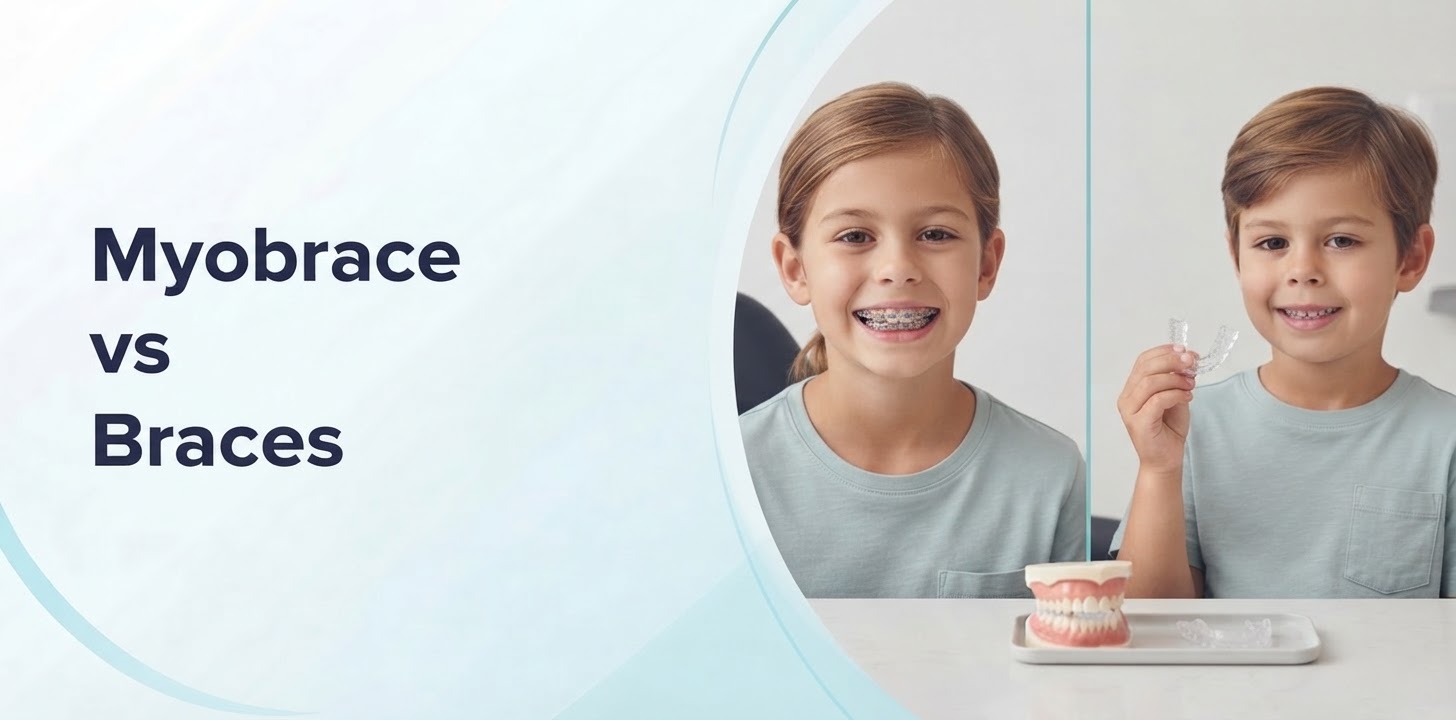
Myobrace vs Braces: What’s the Difference?
This is the comparison parents ask about most, and the answer is that they do different jobs rather than competing.
Myobrace | Braces | |
Typical age | 3–15 (best 5–10) | Usually 11+ |
How it works | Trains habits, guides growth | Moves teeth with fixed brackets |
Removable? | Yes — 1–2 hrs day + overnight | No, fixed |
Addresses breathing/habits | Yes | No |
Wear-time dependent | Heavily | Not at all |
Pain | Minimal, mild pressure at first | Moderate, especially after adjustments |
Typical duration | 12–24 months | 18–36 months |
Braces straighten teeth that have already come through crooked. Myobrace tries to change the conditions that made them crooked. For some children — particularly those starting at 5 to 8 with clear habits and early crowding — Myobrace does most or all of the work. For others, Myobrace improves the foundation and a shorter course of braces finishes the job, usually with a more stable outcome than braces alone.
Be wary of any clinic promising that Myobrace will make braces unnecessary for every child. That is not how it works, and the honest version of the pitch is more compelling anyway.
Myobrace vs Clear Aligners
Clear aligners such as Invisalign are for a different job again. They are excellent at moving teeth — including for teenagers — but they operate on tooth position, not on muscle habits or airway. They also generally require all or most of the permanent teeth to be present before treatment starts.
There is a reasonable overlap for a child around 11 to 13 who has finished Myobrace and needs final alignment. Some clinics use aligners in that final phase instead of fixed braces. What aligners will not do is retrain a tongue that pushes forward on every swallow, or open a nasal airway.
Myobrace vs. Invisalign for Kids in Dubai
Meta description: Myobrace vs Invisalign for kids in Dubai — which treatment suits your child, how they differ on age, habits and cost, and how to choose.
Two Treatments, Two Different Jobs
Parents often ask which is better, but Myobrace and Invisalign are not competing for the same child. They solve different problems at different stages of growth.
Myobrace is a preventive, pre-orthodontic system for children aged 3 to 15, best started between 5 and 10. It does not move teeth with plastic trays. Instead, it retrains myofunctional habits — mouth breathing, tongue posture, tongue thrust and swallowing patterns — so the jaws develop enough room for adult teeth to erupt straight. Your child wears a soft, removable appliance one to two hours daily plus overnight, alongside short tongue and breathing exercises.
Invisalign is a clear aligner system that moves teeth that have already come through. Because it works on tooth position rather than muscle function or jaw growth, it generally suits older children and teenagers — typically once most permanent teeth are present, around 11 or 12 and up. Trays are worn 20 to 22 hours a day.
Myobrace | Invisalign | |
Best age | 3–15 (ideal 5–10) | Usually 11+ |
Works on | Habits, breathing, jaw growth | Tooth position |
Daily wear | 1–2 hrs + overnight | 20–22 hrs |
Addresses mouth breathing | Yes | No |
There is real overlap. A child who finishes Myobrace may still need final alignment, and some Dubai clinics use clear aligners for that last phase instead of fixed braces. Others combine Myobrace with Invisalign for a more stable long-term result.
Cost-wise, Myobrace in Dubai typically runs AED 3,000 to AED 15,000, while clear aligners generally cost more. Neither is usually covered by basic UAE dental insurance.
The honest answer: if your child is young and mouth-breathes or shows early crowding, assess for Myobrace first. If they are a teenager with fully erupted teeth, Invisalign is the more likely fit. A proper assessment — not a price list — should decide it.

What Myobrace Costs in Dubai
Cost is where Dubai-specific information is genuinely helpful, because published figures vary widely.
A realistic range for Myobrace in Dubai is approximately AED 3,000 to AED 15,000, depending on the treatment plan and complexity of the case. Lower starting prices advertised by some providers usually cover an initial phase or a single appliance; comprehensive programmes that run through multiple stages cost more. One Dubai clinic publicly advertises a starting point in the region of AED 3,999 for a Myobrace programme for children aged roughly 5 to 15.
For context, children’s braces in Dubai commonly sit between AED 5,000 and AED 15,000, depending on appliance type and complexity.
What drives the price
- Number of appliances. A two-appliance habit-correction plan costs far less than a four-stage programme with arch development.
- Treatment length and number of review visits. Dubai clinic fees are usually bundled as a programme or charged per phase.
- Additional appliances. Biobloc, BWS or a Myolay for a younger sibling adds to the total.
- Diagnostics. X-rays, photographs, airway assessment and sometimes an ENT referral.
- Whether braces follow. A hybrid plan (Myobrace then a short brace phase) costs more overall than Myobrace alone.
- Clinic credentials and location. A specialist paediatric dentist or orthodontist in a Jumeirah, Marina or Downtown practice will typically charge more than a general clinic in a lower-rent area.
What to ask about money before you start
- Is the quoted figure for the whole programme or per appliance/phase?
- What happens financially if treatment runs longer than estimated?
- Are review visits included, and how frequent are they?
- Is there a payment plan, and does the clinic offer instalments across the treatment period?
- Does your dental insurance contribute? This matters a great deal in the UAE — the DHA-mandated basic plan covers emergency dental treatment only, while comprehensive plans may cover part of general dentistry with a co-pay. Orthodontics and preventive orthodontic programmes are typically excluded from all but the most premium policies.
- Is a consultation chargeable, and is there a written treatment plan before you pay anything?
Get the plan in writing. A clear, itemised proposal from a clinic is a good sign; a verbal price that changes at each visit is not.
Air Travel, School Terms and Dubai Logistics
Two practical notes specific to living here.
Summer travel. Dubai families travel heavily in July and August. If your child is in the middle of an active phase, plan around the trips. Appliances can be worn on holiday — the routine does not stop — but lost or broken appliances abroad are harder to replace, so carry a spare if the clinic offers one.
School-year scheduling. Booking review appointments during the school term on a Thursday or a weekend slot keeps the programme on track. Clinics in Dubai are typically busiest in September and January; book the first consultation early in the term rather than during a peak.
Weather and hydration. Children mouth-breathe more when their nose is dry and irritated. In the cooler months, when Dubai’s dust and pollen counts shift, some children’s nasal symptoms improve and their breathing habits change. Mention seasonal patterns to your dentist when you come in — it is useful diagnostic information.
How to Choose a Myobrace Provider in Dubai
Myobrace is a system, and like any system it depends on the hands using it. When evaluating a clinic, look for:
Formal Myobrace training. Ask directly whether the treating dentist or orthodontist holds Myobrace certification and how many cases they have run. The manufacturer maintains a network of trained practitioners, and Dubai has paediatric dentists and specialist orthodontists working with the system — for example, practitioners at established UAE practices who list Myobrace among their treatment options.
A proper diagnostic step before any quote. A credible assessment includes a look at the teeth and bite, the jaw development, the tongue and lip function, the breathing pattern, and a conversation about sleep. If a clinic quotes you a price without examining all of that, look elsewhere.
Airway awareness. Ask what they do when nasal obstruction is the driver — do they refer to an ENT or an allergist? The best clinics coordinate with other specialists rather than treating the appliance in isolation.
Photos, records and tracking. Progress in Myobrace is gradual, and it is genuinely hard for a parent to see month to month. A clinic that takes standardised photographs, models or scans at each stage is a clinic that can show you objectively whether it is working.
A willingness to say no. If a clinic tells you Myobrace is not the right fit for your child, or that braces will still be needed, that is a good sign — not a lost sale.
Child-friendly practice. Look for a practice used to treating children, with a play area, a dentist who explains things at child height, and a first visit that is about rapport rather than treatment. A six-year-old who trusts their dentist wears their appliance far more consistently.
Practical Tips for Parents and Kids
The mechanics of success are mostly behavioural, so a few things help more than any appliance upgrade:
- Anchor the daytime wear to a fixed routine. Same time, same place, every day. Habits beat willpower, especially for a child.
- Explain why. “It helps you breathe better at night and have strong teeth without braces” lands with a school-age child far better than “because the dentist said so.”
- Show progress, don’t just track it. Use the clinic’s photographs. Children engage with visible change.
- Let the child have some control. Which colour case, when in the routine the hour happens, a sticker chart — small ownership reduces resistance.
- Watch the nose. If your child is congested, treat the congestion. Talk to your dentist or doctor about allergy management, and about whether an ENT referral makes sense.
- Don’t stop early. The retention stage is the least exciting and the most important. Straight teeth held by unresolved habits relapse.
- Keep them brushing. The appliance is a great opportunity to talk about oral hygiene, and Dubai’s paediatric clinics see plenty of cavities that could have been avoided with a little routine.
Myobrace in Dubai for Kids — By Dr. Basel Mofti
Myobrace is a preventive orthodontic system designed for children aged 3 to 15, and it works on a simple principle most parents find surprising: crooked teeth are usually a symptom, not the problem. Mouth breathing, thumb sucking, tongue thrusting and incorrect tongue posture change how the muscles of the face work — and muscles shape growing bone. When the tongue never rests in the roof of the mouth, the upper jaw stays narrow, and teeth erupt with nowhere to go.
Rather than waiting for the teens and straightening those teeth with braces, Myobrace retrains the habits behind the crowding. Your child wears a soft, removable appliance for one to two hours during the day and overnight while sleeping, supported by short daily tongue and breathing exercises. Over four stages — habit correction, arch development, dental alignment and retention — the jaws get the room they need for adult teeth to come in naturally.
For Dubai families, there is an extra consideration: dust, seasonal pollen and constant air conditioning make allergic rhinitis very common here, so many children mouth-breathe because their nose is genuinely congested. A proper assessment looks at the airway as well as the bite, and may involve an ENT or allergy referral alongside treatment.
Dr. Basel Mofti offers child-friendly Myobrace assessments across Dubai, with a full diagnostic review before any treatment plan is quoted. Most programmes take 12 to 24 months, and success depends heavily on consistent wear. If your child snores, keeps their lips apart at rest, sucks their thumb or already shows early crowding, an early assessment is worth booking — the best window is between 5 and 10 years old, while growth is still doing the work for you.

Frequently Asked Questions
Myobrace is designed for children aged 3 to 15, with the best window between 5 and 10 years old. Children in this range respond fastest because habits are still forming and jaw growth is active. That said, it is normal for a child starting at 5 to 10 to have only a few adult teeth — the treatment is about guiding growth, not about moving the permanent teeth that have already arrived.
Expect roughly AED 3,000 to AED 15,000 depending on the treatment plan and case complexity. Advertised starting prices, such as around AED 3,999 at one Dubai clinic, usually cover an initial phase rather than a full multi-stage programme. Children's braces in Dubai, for comparison, commonly run AED 5,000 to AED 15,000.
No. There may be mild pressure or sensitivity for the first few days while your child adapts, and then it should stop. Myobrace uses no metal brackets or wires, and the appliances are flexible and soft.
Most programmes run 12 to 24 months, though with good compliance the manufacturer suggests two to three years is sometimes required depending on growth and other health factors. Your child's timeline depends on compliance, growth stage and case complexity.
One to two hours during the day plus overnight while sleeping, every day, alongside short daily exercises. The overnight wear is the part that does the heavy lifting.
Possibly. Myobrace helps the teeth and jaws grow naturally to accommodate all the adult teeth. Where a family wants perfect "picket fence" alignment, or where the case needs it, braces are sometimes used for a short period at the end — often alongside Myobrace for Braces to protect the habit gains.
Often substantially, particularly in younger children with clear myofunctional habits and early crowding. It is not a guarantee, and any clinic promising it will remove the need for braces in every case should be treated with caution.
No. Suitability depends on dental and jaw development, the type of malocclusion, airway status, oral habits and the child's ability to cooperate. A proper assessment is the only way to know.
Generally not, if the myofunctional problems have been corrected. The practitioner monitors stability throughout the programme, and one of the advantages of Myobrace is that many children avoid the indefinite fixed retainer that usually follows conventional orthodontics.
There have been no reported harmful effects. The appliances exert light, intermittent forces designed to retrain muscles and breathing patterns rather than force teeth.
Far far away, behind the word mountains, far from the countries Vokalia and Consonantia, there live the blind texts. Separated they live in Bookmarksgrove right at the coast
It supports wider arch development indirectly, by improving tongue posture and muscle function — the tongue is the body's natural palatal expander. It works differently from a fixed palatal expander, and the two are used in different situations, sometimes together.
Usually not fully. Basic DHA-mandated insurance covers emergency dental treatment only, and orthodontic or preventive orthodontic programmes are typically excluded from all but the most premium plans. Some comprehensive policies contribute to part of the cost with a co-pay. Confirm directly with your insurer and the clinic before starting.
Yes, but the airway has to be addressed too. If the nose is blocked, the child will keep mouth breathing regardless of the appliance. Good practitioners assess the airway first and refer to an ENT or allergy specialist where needed, then use Myobrace to consolidate nasal breathing once the nose is clear.
Typically every four to eight weeks to check fit and progress and to move your child to the next appliance when the time is right. Frequency can vary by stage.
Treatment is commonly used up to around 15. Beyond that, conventional orthodontics is usually the better route, though adults are increasingly treated with myofunctional therapy in combination with aligners or braces. For an older teenager with significant crowding, a specialist will often combine the approaches.

A Note Before You Book – Myobrace in Dubai
Myobrace is one of the more interesting developments in children’s dentistry — an approach that treats the cause of crowding rather than the symptom, and one that takes breathing, sleep and facial growth seriously. For the right child, at the right age, with a committed family, it can meaningfully change the orthodontic path ahead.